CFD Engineering Applied to Industry and Energy

Computational Fluid Dynamics (CFD) enables the analysis of complex phenomena such as flow, heat transfer, contaminant dispersion, and aerodynamic behavior using advanced numerical models. At INCIMAT, we use CFD simulation as a decision-making tool, allowing us to evaluate different scenarios before implementation and optimize the design of facilities, equipment, and processes.

Our studies combine detailed three-dimensional models with real operating conditions to reproduce the behavior of fluids, gases, and particles in complex industrial environments. We analyze both steady-state conditions and transient phenomena, taking into account factors such as turbulence, temperature, wind, emissions, pressure drops, and interactions with structures and equipment.

The goal is not merely to generate numerical models, but to provide technical solutions that improve safety, operational efficiency, and facility performance.

Sectors of Operation

• Refining and petrochemicals
• Energy and power generation
• Chemical industry
• Process industry
• Industrial infrastructure
• Environment
• Waste management
• Fluid storage and transportation
• Unique buildings
• Logistics and industrial facilities

Our Capabilities

✓ Fluid flow simulation
✓ Heat transfer
✓ Atmospheric dispersion
✓ Wind studies
✓ Industrial ventilation
✓ Fire and smoke simulation
✓ Process optimization
✓ Pressure drop analysis
✓ Transient studies
✓ Evaluation of design alternatives

CFDIncimatModel3.fw
CFDIncimatModel2.fw
CFDIncimatModel1.fw

Gas Dispersion and Emissions

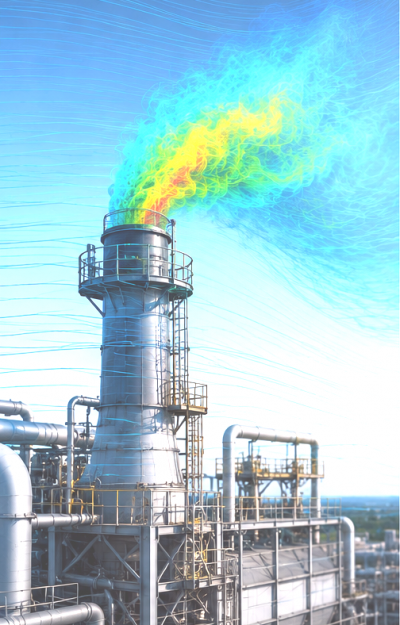
We analyze the behavior of atmospheric emissions from smokestacks and industrial facilities, evaluating concentrations, trajectories, and potential impacts on the environment. These studies enable us to optimize emission heights, locations, and operating conditions.

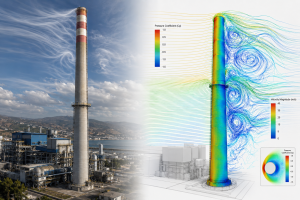
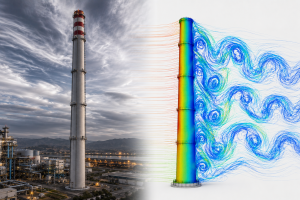
Wind Studies

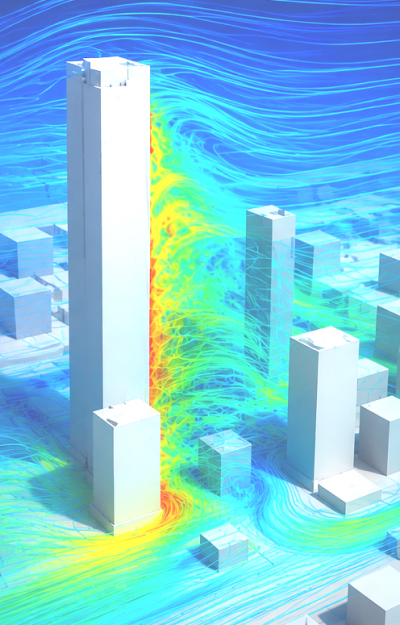
We simulate the interaction of wind with buildings, industrial structures, chimneys, towers, and other infrastructure. We evaluate wind speeds, turbulence, recirculation, and pressure distributions to improve the design and safety of facilities.

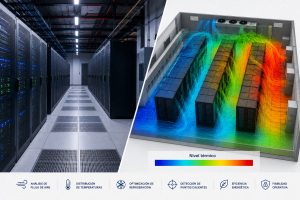
Industrial Ventilation

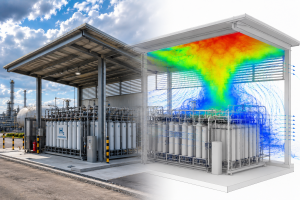
We study airflow in buildings and industrial facilities to optimize ventilation, exhaust, and air renewal systems, ensuring proper operating conditions and safety.

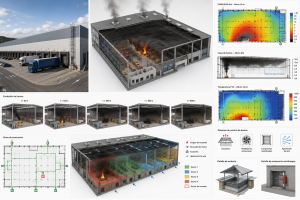
Fire and Smoke Simulation

We model the spread of smoke, hot gases, and combustion products in open or enclosed spaces. These studies enable us to evaluate emergency scenarios and design more effective protective measures.

Thermal Analysis

We evaluate heat transfer phenomena—including conduction, convection, and radiation—in equipment, ducts, and industrial facilities. We analyze temperatures, thermal gradients, and energy efficiency.

Equipment and Process Optimization

We use CFD to improve the performance of industrial equipment, reduce energy losses, and optimize processes such as transport, mixing, separation, and heat transfer.

Duct and Pipe Networks

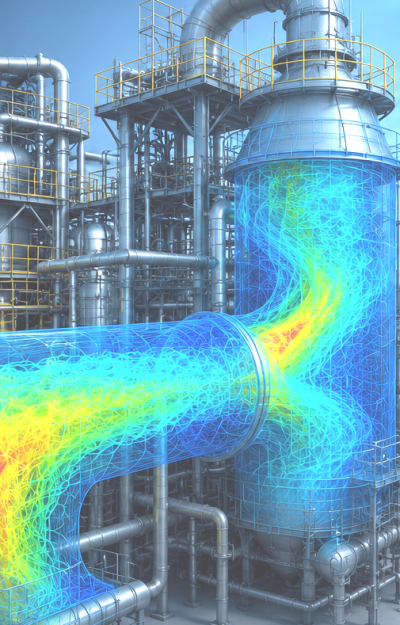
We analyze flow behavior in complex duct and pipe systems, evaluating pressure drops, flow rate distribution, recirculation zones, and hydraulic behavior.

Particle and Contaminant Simulation

We model the transport of solid particles, aerosols, and suspended contaminants to evaluate their dispersion, deposition, and behavior within industrial processes or in the environment.

We turn simulation into practical engineering. Do you need assistance with a CFD study?

Beyond generating numerical models, our goal is to provide technical solutions that enable us to optimize designs, improve facility performance, and reduce risks throughout all phases of the project. Our team can assist in the analysis, validation, and optimization of industrial facilities, infrastructure, and energy systems through advanced simulation.
error: Content is protected !!