
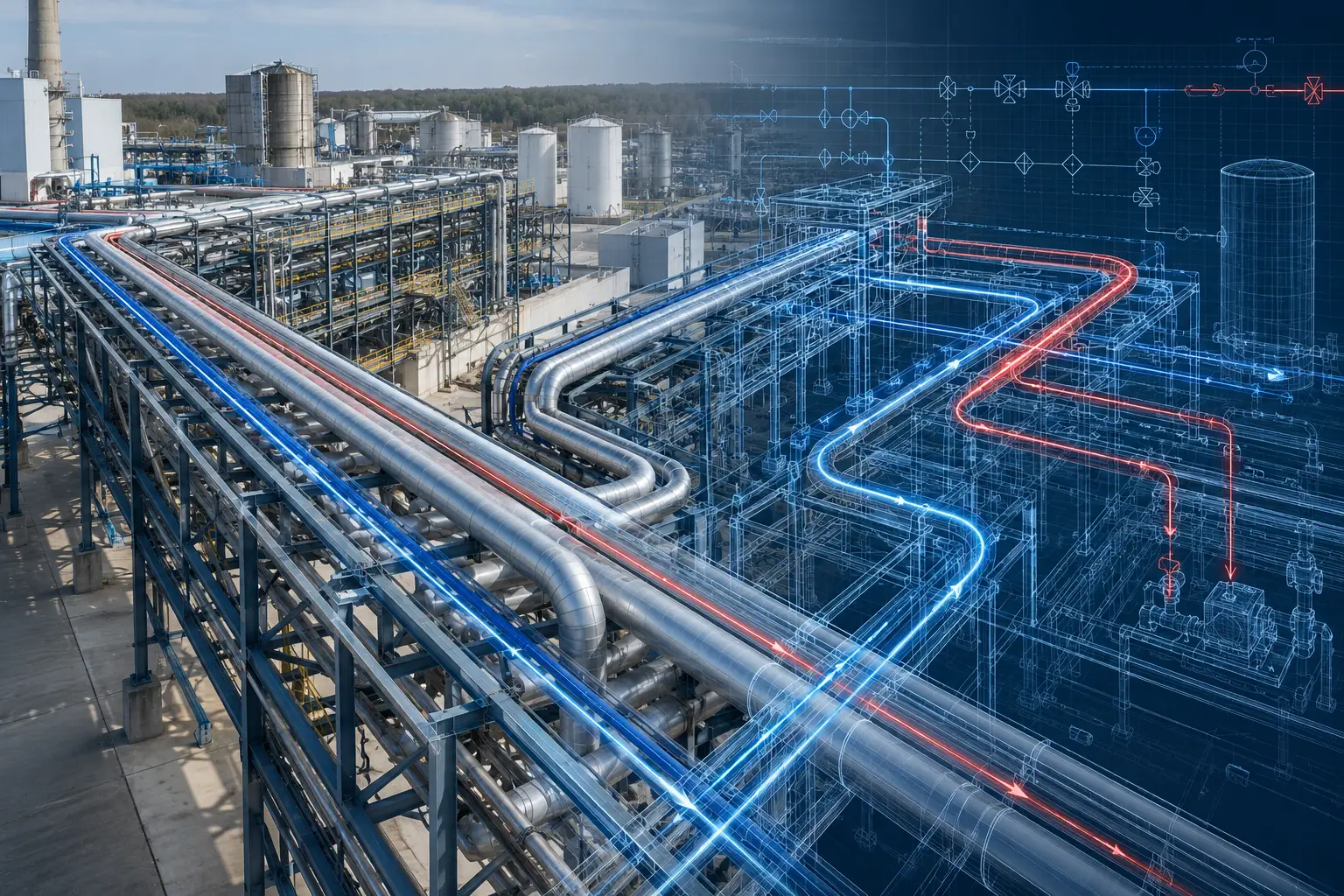
Modifications to existing industrial facilities require ensuring that any changes introduced do not adversely affect the performance of critical process systems. In this project, INCIMAT carried out a comprehensive hydraulic study to assess the feasibility of relocating several industrial gas distribution lines affected by a facility modernization and redevelopment program.
The primary objective was to analyze the hydraulic behavior of different gas distribution networks and verify that the proposed rerouting would not introduce pressure losses or operational changes capable of compromising the service conditions of the existing systems. To achieve this, the geometric characteristics of the pipelines, operating conditions, network components, and representative operating scenarios were thoroughly evaluated.
The engineering work included hydraulic modeling of the existing pipeline systems, pressure loss calculations, assessment of available pressures, and a comparative analysis between the original configuration and the proposed new routing arrangement. Due to the limited availability of detailed information regarding certain downstream consumption points, a parametric methodology was adopted, allowing the evaluation of system performance under different demand scenarios and determining the sensitivity of the installation to operational variations.
Based on the results obtained, a new pipeline configuration was developed, optimizing routing layouts and adapting the installation to the new site requirements without modifying the principal characteristics of the existing piping systems. The study demonstrated that the proposed solution maintained hydraulic conditions equivalent to, or more favorable than, those of the original installation, ensuring continuity of service throughout the planned modification works.
This type of project forms part of the industrial engineering services provided by INCIMAT for energy and process facilities, combining hydraulic analysis, pipeline network design, technical feasibility studies, and the adaptation of existing infrastructure to new operational requirements.